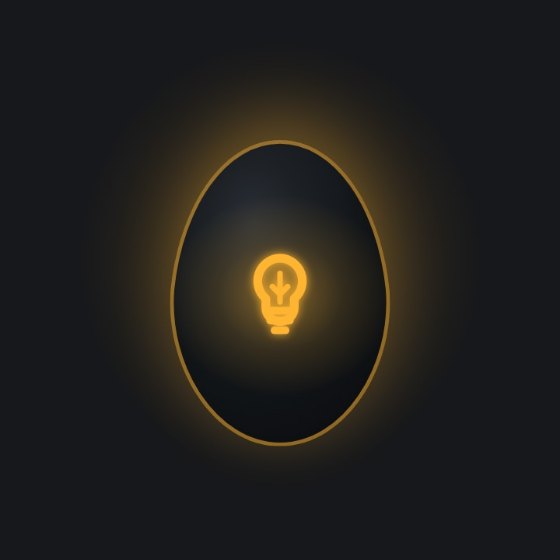
Darkfactory
A subsidiary of ALXEVT · brand of ABS COMPANY INC.
What it is
Darkfactory takes a rough business idea and returns a production‑ready web tool and website within twenty‑four hours, with the client appearing exactly once — at the start. A floor that runs with the lights off: the work is automated end to end, which is where the name comes from and why the mark is the one unlit egg in the family. A subsidiary of ALXEVT, operated by ABS COMPANY INC. of Jersey City, New Jersey.
The mark, read
- The egg
- Life — that which is about to exist, and the form every ALXEVT subsidiary wears. The silhouette is the family, and it is read before the company is. It is never bare and never circled by orbitals — that is the parent’s Palladium Egg — and never visored, which belongs to the Saint Egg.
- The unlit shell
- The one place in the family where the metal is off. This company is a dark factory — lights‑out production — and a bright palladium shell says the opposite of that. It is the same palladium as its sisters with the light taken away, not a new metal and not a new rung: on the maturity ladder this company still points at palladium, and inside ALXEVT’s own registry it is still graded honestly at foundation. The amber contour is the only light that escapes, and it is there for a plain reason as well as a poetic one: on a near‑black tile an unlit egg without a rim has no silhouette at all.
- The inlay — the lamp
- One lamp, lit, inside a shell that is otherwise dark — and the light it throws on the inside of the shell is drawn, so the lamp is the source of everything visible in the mark. A dark factory is not an empty building; it is a building that is working without anyone needing to see. The lamp is the single point where that stops being true, which is also this company’s delivery model: the client appears exactly once, to approve a BRD, and the floor runs unlit on either side of that moment. It is the ordinary bulb, not a machine, because the thing worth drawing is the light rather than the worker. Status: adopted.
- The dark tile
- The Solari departure board is the stage on which the parent announces itself, and this company would inherit it one stop darker: the board as the factory’s single lit window on an unlit building. The rows would read as the standing timetable — intake, research, BRD, SRS, build, ship — with amber spent exactly once, on the BRD row, the one line where a client exists. The treatment stays visibly distinct from alxevt.com’s own board, so parent and subsidiary never read as one company.
The delivery model
The model below is designed, not demonstrated. It states how the company would work if it were operating. Nothing in it has been run for a client, and no figure in it has been measured.
- Input
- An open, rough business idea — a sentence, not a brief. Nothing needs to be specified at entry: no requirements, no feature list, no wireframes. An input that is already fully specified is work for a sibling company, not for this one.
- The gates
- Four, in order. An understanding check — minimal questions, only enough to confirm the idea was read correctly. Then market and competitor research, done autonomously. Then a BRD carrying that research, sent for approval. Then an SRS specifying the features to the best standard the domain has, frozen before the build begins.
- Client involvement
- Two touches, one of which is a decision. The client answers the understanding questions, then approves or rejects the BRD. Before, between and after those points the client spends no time. The BRD is the only place the product can still be steered.
- Output
- A production‑ready product in two pieces: the web tool and the website that fronts it — built to ship, not to demonstrate.
- The window
- 24 hours, from confirmed intake to a product that is live. That is the specification the company holds itself to.
- The trade
- Speed and autonomy, bought with a very narrow steering window. A client who wants to shape the product while it is being built is asking for continuous co‑definition, which is PSAIO’s model, not this one. Painting a deadline into an identity carries its own cost, and it is stated rather than hidden: a missed window would be a public failure by construction.
- What “dark” means
- Lights‑out production — a floor that needs no lighting because no human is standing on it. The claim is about the floor and nothing else. The client exists, at intake and at the BRD; the term has to be explained before it can reassure, which is why it is explained here first.
- Where it sits
- The four business models of the five ALXEVT companies lie on one axis, from the client defines everything with us to no client exists yet: PSAIO, Board of Experts, Darkfactory, Agentic Business Studio. Darkfactory is second from the autonomous end — it takes the least defined input of the three commissioned models, and returns the least client time.
What exists today
A company’s first asset is a decided model. Darkfactory has one, with the window written into it.
- The name and the mark
- Both settled and adopted. Darkfactory, one word, and the one unlit egg in the family with the lamp inlaid — a floor that runs with the lights off, and the single light that escapes it. ados darkfactory, a SAINT product, shares the name deliberately: the tool is named for the company whose model it runs.
- The delivery model, complete
- Four gates, in order. An understanding check — minimal questions, only enough to confirm the idea was read correctly. Then market and competitor research, run autonomously. Then a BRD carrying that research, sent to the client for approval. Then the SRS, and the build. The client steers at exactly one point, and it is the point that decides the product.
- The commitment
- Twenty‑four hours, from confirmed intake to a product that is live — a production‑ready web tool and the website that fronts it, built to ship rather than to demonstrate. That is the specification the company holds itself to.
- Operator of record
- ABS COMPANY INC., Jersey City, New Jersey — the operator behind ALXEVT and behind this company. Correspondence: developer@alxevt.com.
What it inherits
Every ALXEVT company is the same egg — the family form — with one instrument inlaid to say what it specialises in. Four of the five are palladium. Darkfactory is the exception: its shell is unlit, because a dark factory is a floor that runs with the lights off, and a palladium egg cannot say that. The bare shell and the three orbitals belong to the parent alone (the Palladium Egg), and the visor belongs to the Saint Egg. The companies also inherit the parent’s ascent picture, its 16 Pillars as cross‑cutting method, and its technological stack.
The metal is deliberate: palladium is the target of the maturity ladder, not the rung any of these companies has reached — and Darkfactory’s unlit shell is the same palladium with the light off, not a different metal, so it stands on the same ladder. They are drawn at the level they aim for, because the goal is meant to be a hard one.